A Faint, Compact Galaxy at z=14
Wu et al. (2025) The Astrophysical Journal, arXiv:2507.22858
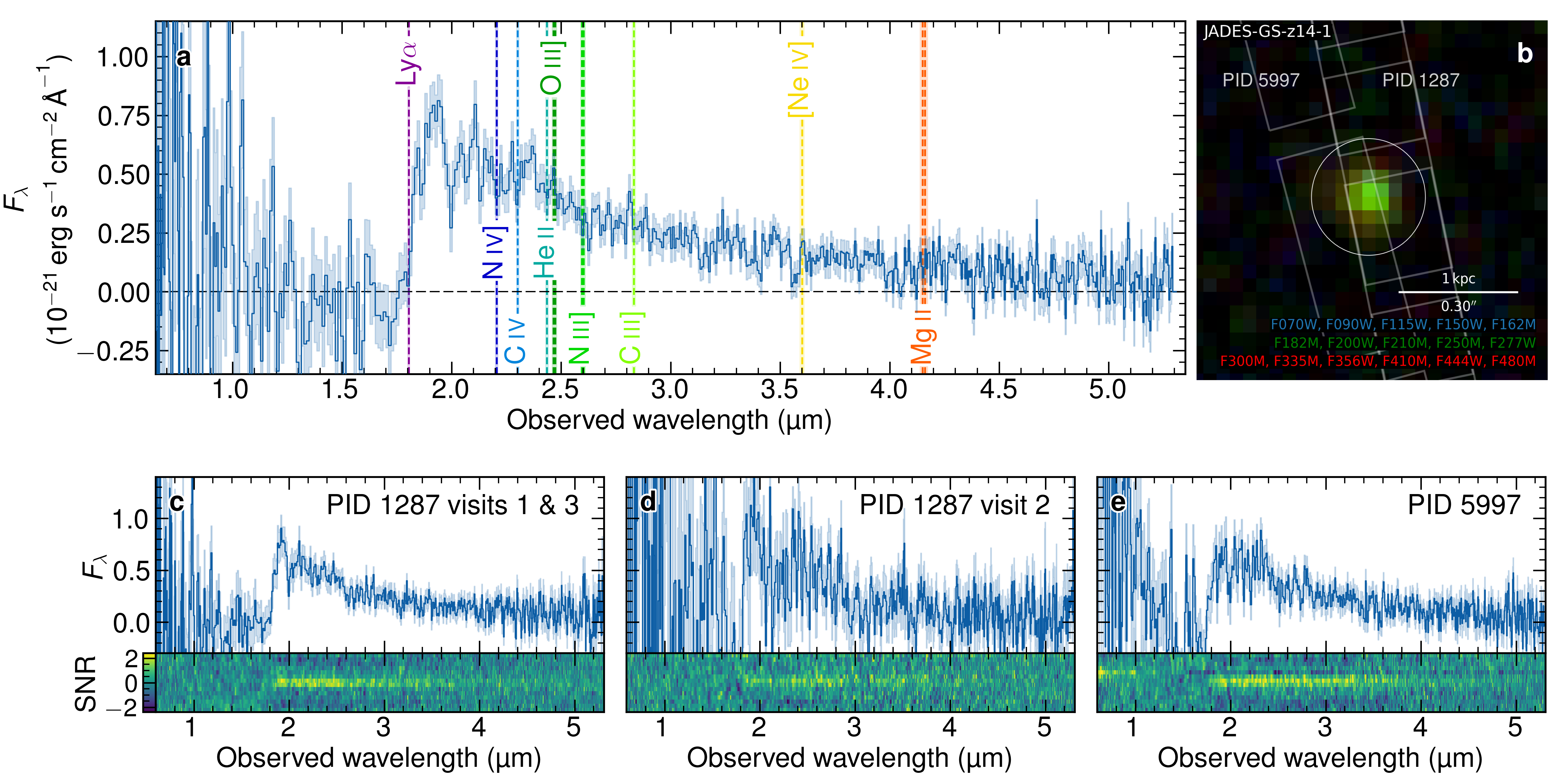
I led the analysis of extremely deep JWST observations of JADES-GS-z14-1, one of the most distant galaxies at z = 13.86.
To enable robust flux measurements under low signal-to-noise conditions, I build a tool to perform photometry on individual exposures in NIRCam and MIRI. I analyze the NIRSpec prism data accounting for inter-channel covariance, which ensures accurate measurement of faint spectral features.
Our analysis reveals that this low-luminosity galaxy has weak metal emission lines, in contrast to the strong lines in luminous z > 10 objects. The weak lines suggest a low metallicity and potentially a high escape fraction, and may imply difference in the physical properties between luminous and faint galaxies at z > 10.
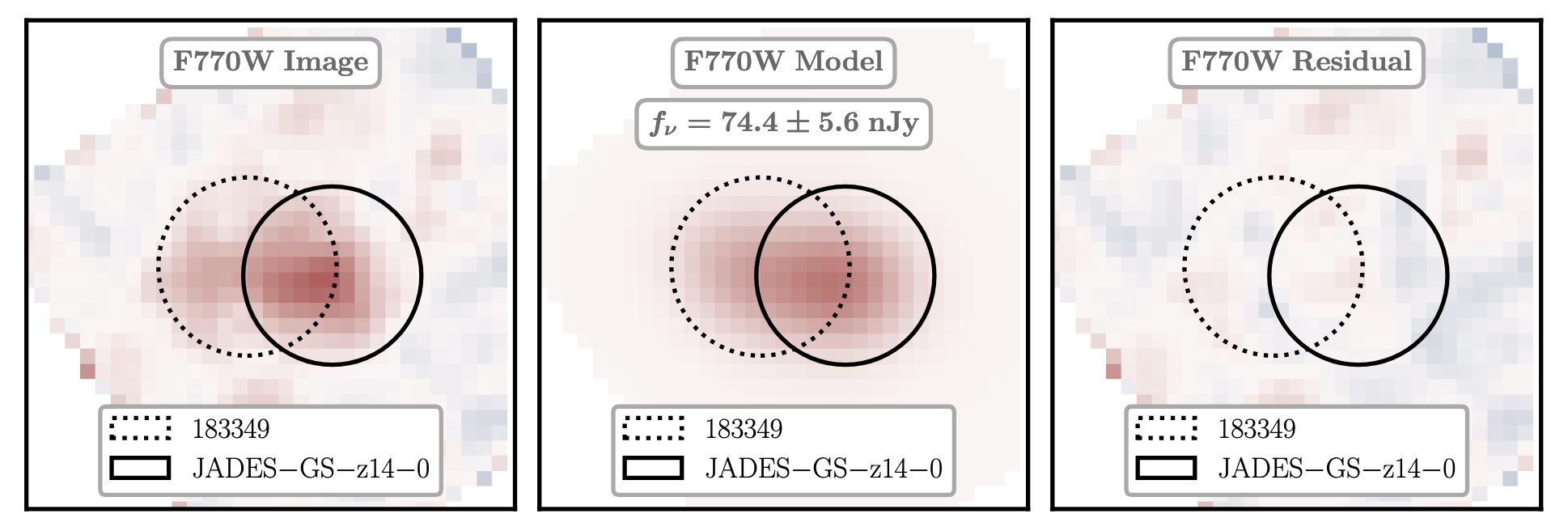
MIRI Detection of JADES-GS-z14-0 at z=14
Helton et al. (2025) Nature Astronomy
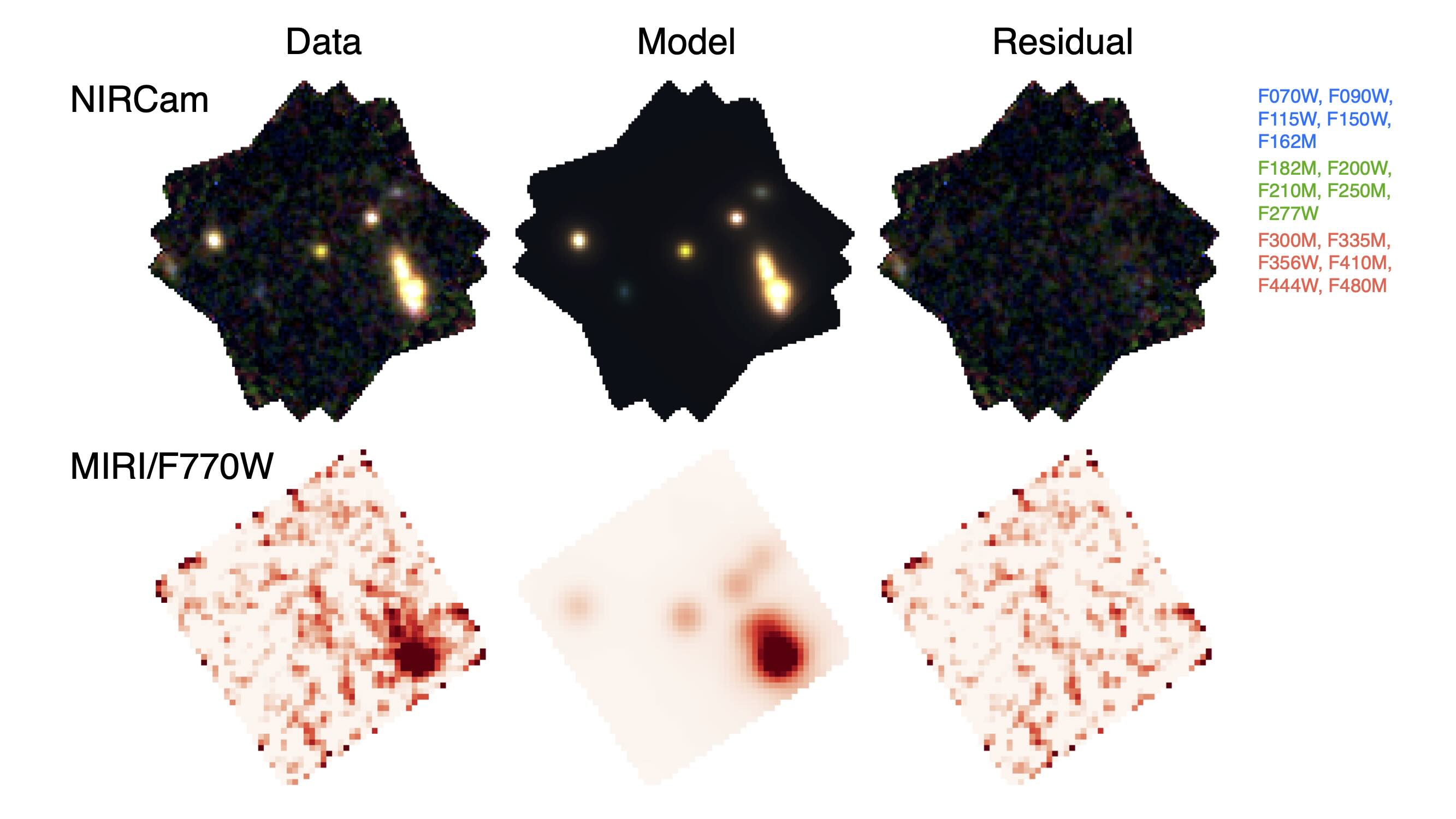
I develop advanced techniques for high-precision measurements of faint galaxies in the early universe. I developed an advanced linear algorithm to disentangle the MIRI emission of JADES-GS-z14-0 from a foreground contaminant, leveraging the higher-resolution spatial information from NIRCam to model the MIRI source structure. The method performs forced photometry on individual exposures while rigorously propagating uncertainties and covariances, which are critical for reliable flux estimation, especially in heavily contaminated situations. This technique has proven accurate and robust, and provided the critical measurement of the MIRI/F770W flux for JADES-GS-z14-0, an extraordinary galaxy at z = 14.
JWST Wisp Subtraction
Wu et al. (2026) arXiv:2601.15958
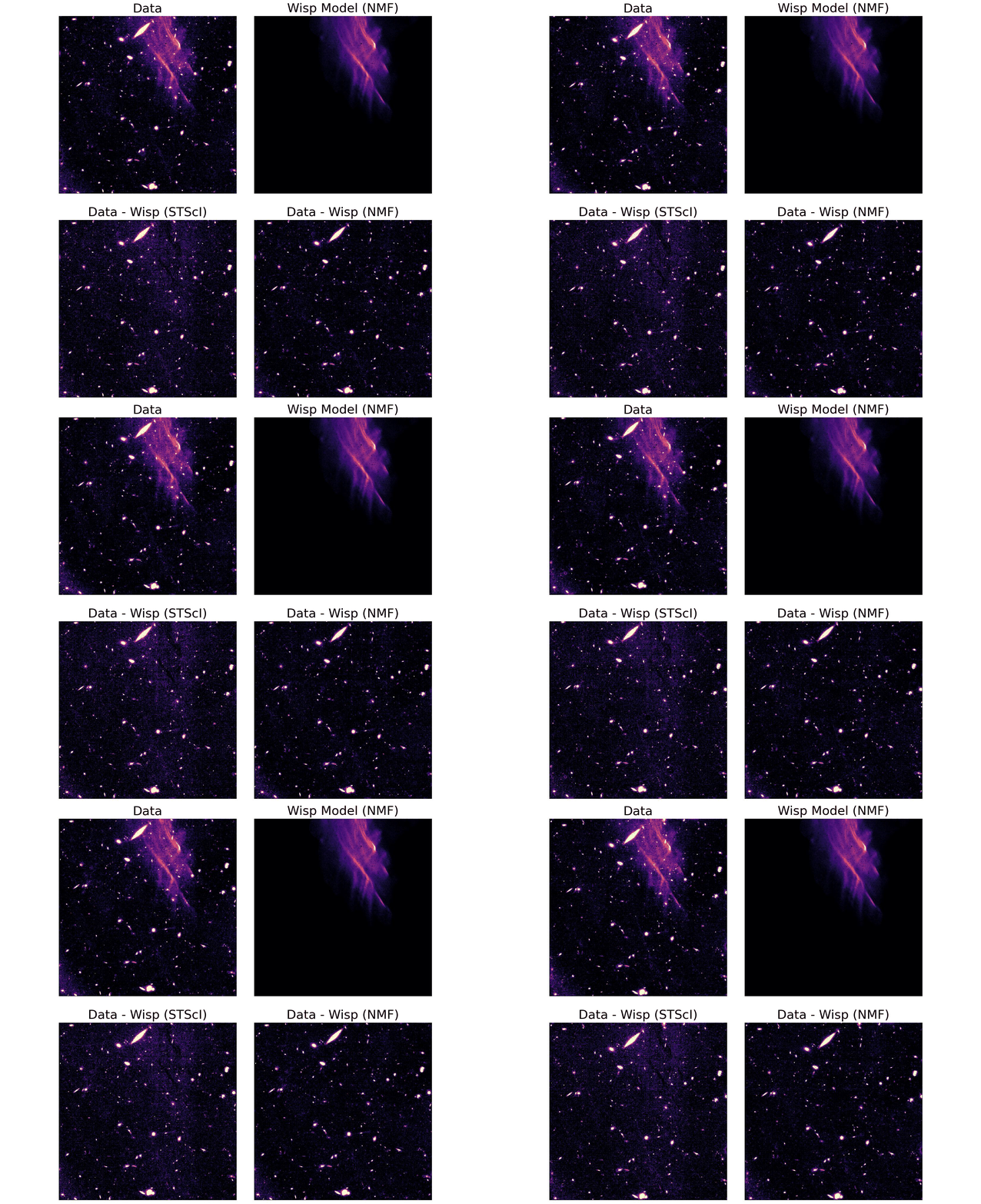
I developed a data-driven method to remove wisp, a severe and widespread scattered-light artifact in JWST NIRCam data, using the non-negative matrix factorization (NMF) algorithm. This technique has been successfully integrated into the latest JADES data reduction pipeline, substantially enhancing the reliability of faint source detection in corresponding regions.
Intermediate-Mass Black Holes (IMBHs) Microlensing
Wu & Ho (2025) The Astrophysical Journal
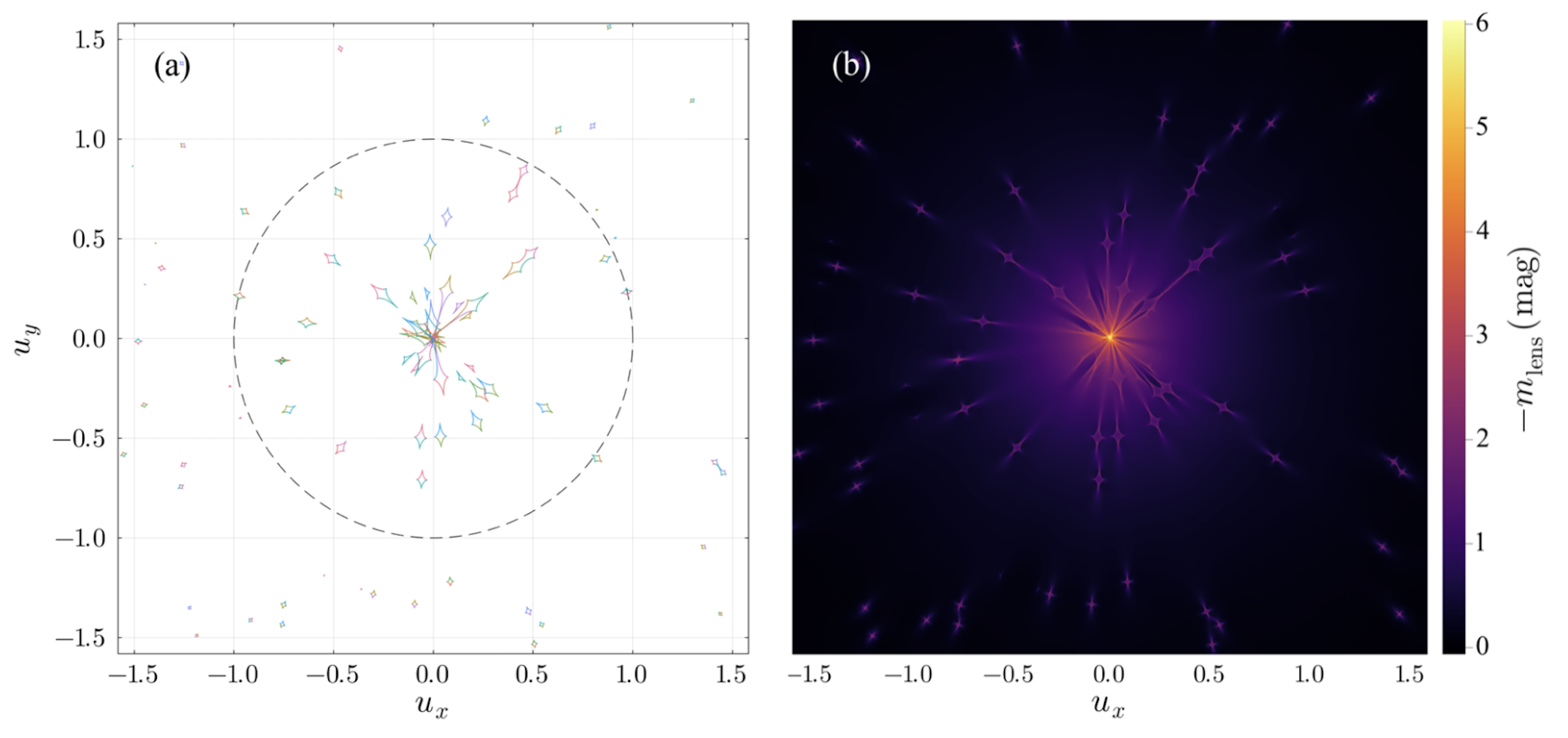
IMBHs are too faint to detect through their electromagnetic emissions. I proposed a method to detect their gravitational lensing effects on background quasars. IMBH microlensing selectively magnifies emissions inside the broad line region of quasars, causing them to appear as high-Eddington, weak-line quasars. Cosmological peculiar motions introduce long-term lensing-induced variability, with the same amplitude across ultraviolet, optical, and X-ray wavelengths. IMBHs embedded within companion stellar clusters can generate complex caustic structures, leading to distinctive and highly variable quasar light curves.
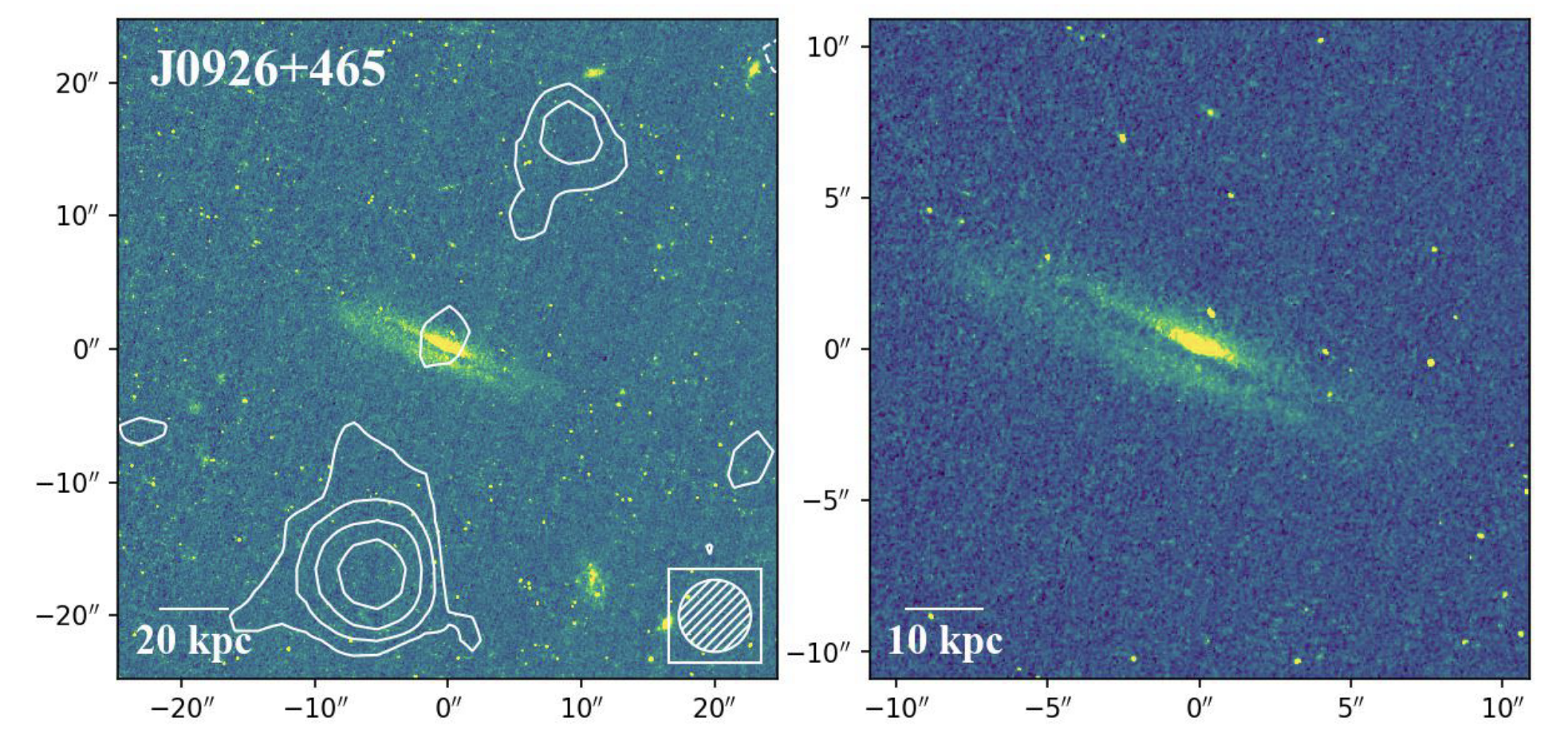
Massive Disk Galaxies with Radio Lobes
Wu et al. (2022) The Astrophysical Journal
It has long been a puzzle why large-scale black hole jets, seen as radio lobes, are almost exclusively associated with elliptical galaxies. To investigate this, I studied a rare sample of disk galaxies hosting radio lobes from the Gems of the Galaxy Zoos project. Our analysis reveals that the apparent preference for elliptical hosts is primarily a consequence of a mass bias: using HST imaging, we confirmed that these galaxies show clear disk morphologies, yet they have exceptionally high stellar masses, on average an order of magnitude above the characteristic mass for disk galaxies, similar to that of giant elliptical galaxies instead. Given the rarity of both massive disk galaxies and jet-producing events, our results suggest that the formation of black hole jets may be fundamentally linked to the stellar mass of the host galaxy. Since stellar mass correlates with black hole mass, this further implies a potential connection between jet production and black hole mass.